
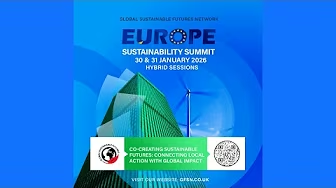
30 January 2026 – London / Europe Region
The Europe Sustainability Summit 2026 officially opened today, marking a significant milestone in the expansion of GSFN’s global mission. Following eight successful Global South Summits, GSFN has launched a bold and inclusive global platform connecting the Global South, South, and North through shared learning, leadership, and sustainability transformation.
Hosted under the theme “Leadership, Systems & Youth Voices,” Day 1 brought together an extraordinary mix of universities, schools, businesses, government representatives, civil society, innovators, researchers, and youth leaders committed to shaping a more resilient and equitable future.
A Powerful Opening: Setting the Context for Europe’s Sustainability Transition
The summit opened with a contextual overview of Europe’s evolving sustainability landscape, highlighting the urgency of:
- transitioning to low‑carbon, resource‑efficient models,
- strengthening governance systems, and
- aligning Europe’s sustainability agenda with global priorities across regions.
The launch reaffirmed GSFN’s dedication to co‑design, co‑production, and co‑implementation through a transdisciplinary and inclusive approach that elevates local voices while strengthening global action.
Keynote: Leadership for a Resilient and Sustainable European Economy
A forward‑looking keynote address explored the pivotal role of leadership in accelerating Europe’s green and economic transition. The session underscored the need to embed sustainability at the heart of competitiveness, innovation, and resilience. Emphasis was placed on developing governance structures capable of responding to climate shocks, managing water stress, and navigating the complex market shifts driven by environmental change.
FireChat Session 1: Global Economic & Sustainability Leadership
The first FireChat of the summit explored how global and European systems must evolve to support long‑term resilience. Key themes included:
- the rising importance of ESG‑driven governance,
- aligning global–European sustainability frameworks,
- bridging gaps between policy ambition and real-world implementation,
- strengthening integrity and accountability across institutions, and
- rethinking economic leadership as a driver of climate and social transformation.
Discussions highlighted that sustainability is no longer an add‑on—it is the new operating system for economic leadership.
FireChat Session 2: Agriculture, Water & Food Systems
This session delved into the interconnected challenges of food security, water stewardship, climate adaptation, and sustainable value chains. Participants explored:
- innovations in agricultural water efficiency and climate‑smart farming,
- the role of AI and satellite data in water resource monitoring,
- the need for circular water reuse across industrial and agricultural systems,
- successful demonstrations of sustainable practices across Africa, Asia, and Europe, and
- integrated approaches that protect ecosystems while boosting productivity.
The conversation reinforced that water is central to both climate resilience and sustainable economic development.
FireChat Session 3: Youth in Sustainability
The final session of the day celebrated the energy, creativity, and leadership of young people across regions. Discussions spotlighted:
- youth innovation in climate‑smart agriculture and water management,
- intergenerational knowledge exchange as a driver of systems change,
- barriers faced by young professionals—particularly in the Global South—related to skills, tools, and resources,
- the importance of providing youth with leadership pathways and paid roles, and
- the need for inclusive platforms that enable young people to co‑lead climate action.
The session concluded with a call to embed youth at the centre of all sustainability transitions.
A Transformative Beginning
Day 1 of the Europe Sustainability Summit 2026 set a compelling foundation for global collaboration. The discussions highlighted the importance of:
- systems thinking and ethical leadership,
- integrated climate resilience strategies,
- evidence‑driven governance,
- innovation in food and water systems, and
- empowering youth as co‑creators of sustainable futures.
GSFN continues its mission to build an equitable, science‑led, low‑carbon world—ensuring no one is left behind.